
A lot goes into choosing which farm’s CSA program to join—and rightly so. A Community Supported Agriculture program is a two-way commitment between you and the farm—a subscription to the farm’s products for the season. Before you devote your CSA budget to a farm, you likely want a few questions answered.
You may not know what those questions are yet, and that’s perfectly normal. Most farmers are happy to explain how their CSA works, but there may be parts of the relationship you wouldn’t think to ask about—especially if this is your first time trying CSA.
To give you a place to start, consider asking your local farmers these questions when shopping around for a CSA. If you happen to be local to Georgetown, Lexington, Louisville, Cincinnati, or Northern and Central Kentucky, we’ve included our answers as well, in case they help you on your CSA journey. We’ve had a CSA program for decades now, and we want shareholders to feel like we’re a good fit when they sign up.
What kind of produce does the farm grow?
You’ll want to make sure your farm is growing food you actually want to eat. Ask about the varieties you can expect during each growing season, and whether they offer add-ons like bread, eggs, flowers, or coffee.
Our Answer
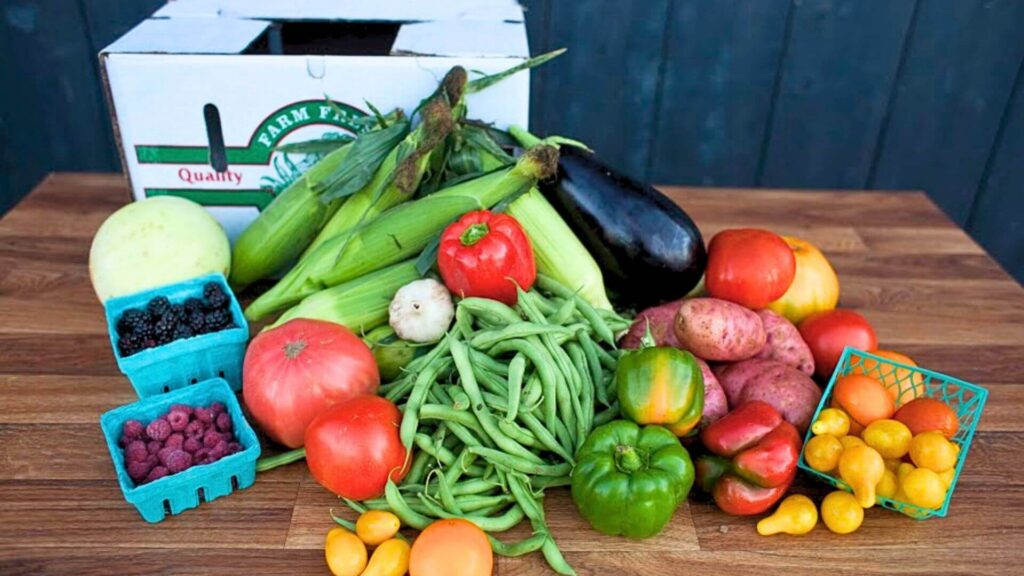
Elmwood grows more than 40 varieties of produce. To name a few: we grow leafy greens year round. Winter and spring bring asparagus, cabbage, turnips, root vegetables, and herbs. Summertime means the arrival of tomatoes, berries, green beans, corn, summer squash, and more. In the fall, crops trend back to cool-weather varieties like broccoli, fall squash, and root veggies. We offer bread, eggs, coffee, and meat add-ons. We also occasionally buy in specialty products for our CSA members, such as fresh fish and organic peaches!
Does the farm choose what goes in my share, or do I get to choose?
Some farms offer a Traditional CSA, which means you’ll receive the farmer’s selection of produce based on what’s in season. Some farms offer a Customizable Share, where each week you can go online to view and modify what’s in your share. Remove items you’d rather not take home (maybe you still have last week’s potatoes) or add extra broccoli if your household goes through it quickly.
Our Answer
While we can’t stress enough that a Traditional CSA is a wonderful way to connect with your local farm, Elmwood Stock Farm is proud and fortunate to offer a Customizable CSA Share to help our CSA shareholders take home produce they’re excited about.
What is the size of a CSA share? Do you offer half-shares or other sizes?
CSA share sizes vary by farm. Some offer one option, while others offer two or three. Check the farm’s website or ask directly to know what to expect.
Our Answer
Elmwood Stock Farm offers 3 produce share sizes. Mini is designed for single adults or couples who eat out often–it won’t overwhelm your fridge. Regular covers most weekly vegetable needs for a small household. Robust is for large families or plant-based households.
How does the farm communicate with shareholders, or educate them on prep and storage tips?
You’ll want to partner with a farm that can speak to you regularly about how harvest is going, as well as how to use what you take home. Most farms offer a weekly newsletter or email.
Our Answer
We put a lot into this! Elmwood sends a printed newsletter in each share with storage instructions, recipes relevant to what's in season, and stories about the farm to keep you grounded in this chaotic world we live in. We also send out weekly emails to our whole community about recent goings-on and product highlights.
What is the farm’s system for keeping produce fresh and cool during transit and storage?
A farm’s freshness management strategy is key to shareholders getting the most out of their local farm relationship. Knowing your farm has a solid plan to get your share to you while it’s still crisp and nutritious can put your mind at ease.
Our Answer
Elmwood Stock Farm uses irrigation to cool and hydrate crops while they grow in the field. We move them indoors to rinse in cool water as soon as they’re harvested, which brings their temperature down quickly. Crops are either bagged, boxed, or bunched depending on how they store best, and are put in our walk-in cooler to reach the optimum temperature before being delivered in an air-conditioned van. Home deliveries are either handed to the shareholder directly or placed in the shareholder’s cooler just outside their home. Pickup orders at hub locations are always placed in a weather-protected area and are often available indoors where it’s cooler in the summer and warmer in the winter. We communicate delivery schedules ahead of time and offer a texting service so members can access their share as soon as possible after delivery.
How often is CSA pick-up? What should I do if I know I'll miss a week?
While most are weekly, frequency can vary by farm. It’s best to check the farm’s website or ask them directly.
Our Answer
Elmwood Stock Farm has a great set up for pausing and resuming your CSA if you know you’ll be out of town—the value of that week’s items carries over to use in a future week—so you never lose out. We offer weekly shares of all of our produce types, as well as add-on shares.
How long has the farmer been farming?
There’s no wrong answer here. You may feel at home with a farmer who’s been doing this their whole life, like their parents before them. Or you may want to support a relatively new farmer as they grow their operation. Depending on what’s important to you, this measure of experience could help build trust between you and your farmer.
Our Answer
Elmwood Stock Farm has been in operation for over six generations. It’s seen many developments, such as a transition from tobacco to direct-to-consumer organic vegetable and meat production. Like their mother and father, Kay and Cecil Bell Jr., John Bell and Ann Bell Stone live on the very farm they manage. Ann’s husband, Mac Stone, is also an integral part of the farm’s daily operation and longevity.
What does the farm do for the environment?
What you ask will depend on what matters most to you. Are you looking for a regenerative, organic, or no-till farm (of which there can be overlap)? You may be trying to avoid synthetic chemicals, avoid GMO production, or you may want to support a farm that focuses on building healthy soil. If ecology is on your mind, have this conversation with your farmer.
Our Answer
Elmwood is a USDA certified organic farm and a Real Organic Project certified farm. This means we prioritize animal well-being, we don’t grow GMOs, and we don’t use synthetic chemical fertilizers, pesticides, herbicides, or additives. Our rotational grazing strategy means we focus on regenerative practices to actively restore soil quality. We give our land chances to rest and regenerate. Our farm also serves as a habitat for a wide variety of wild species—from birds to mammals to bugs—though our livestock and crops are well protected from all three.
We hope you ask these questions of the farms near you and discover what combination of traits suits you best! If you’ve learned enough about us to see yourself as an Elmwood CSA shareholder, check out our shares.
Please drop us a line if you have a question you don’t see answered here.