
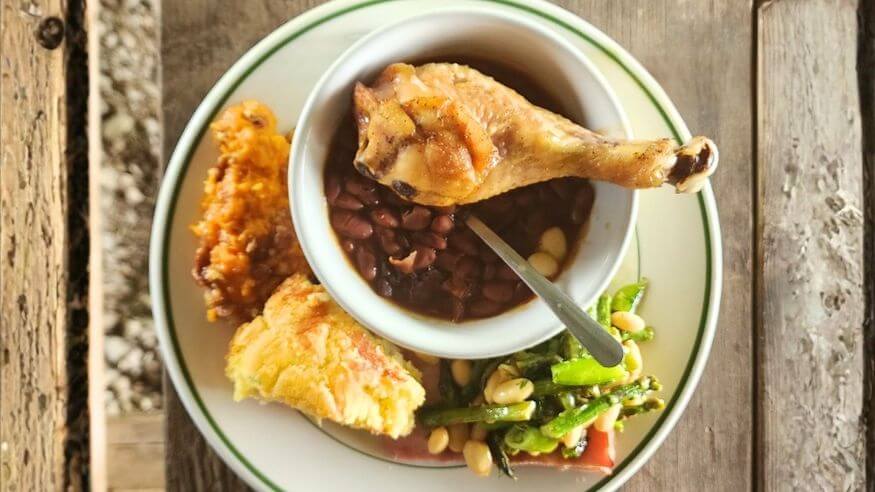
Pictured: A meal cooked on-farm for our team, using Elmwood products.
It’s often said that grass-fed, pasture-raised animal products are more nutritious and better for your health. But how does that nutrition actually form? How do soil, sun, grass, and insects equate to heart-healthy beef or eggs with less cholesterol? This characteristic is key to organic farming, and we’re happy to answer.
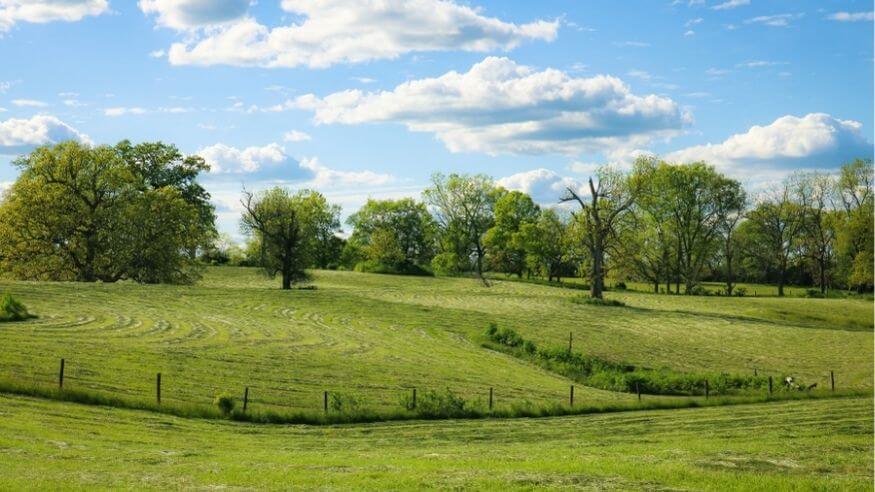
The Pasture Isn’t Just Healthier for Humans. It’s Healthier for the Animal.
Ruminants (sheep, cattle, deer, bison, etc.) are types of mammals that have evolved specifically to graze. Their unique method of digestion is specialized to eat huge quantities of grasses, legumes, herbs, and forbs. Their multiple stomaches create the ideal environment for the fermentation and conversion of that hardy plant material into proteins and other useful nutrients. Our single stomach, which instead relies on enzymes to break down food into usable components, cannot naturally process those tough forages.
These mammals, while they can survive and grow to impressive sizes on a grain-only diet, do not do so naturally. By letting cattle live and graze the way they are specialized to do creates a healthier animal and a healthier product, which we’ll explore momentarily.
Similar things can be said of farm animals that aren’t ruminants: they experience greatly improved qualities of life when given access to the outdoors. Chickens (which are unable to meet their nutritional needs on a grass-only diet and should be fed delicious grains) benefit enormously when able to supplement their diet with bugs, wild-growing seed and grain, and natural soil grit (to aid in digestion). Same for pigs, who supplement their grain diet with roots, fungus, bugs, and grubs. All this allows them to round out and self-regulate their vitamin and mineral intake from day to day.

… Which, In Turn, Provides Better Nutrition for Us.
It’s true! A well-nourished animal creates more nutritious food! And there’s a plethora of data to back this up.
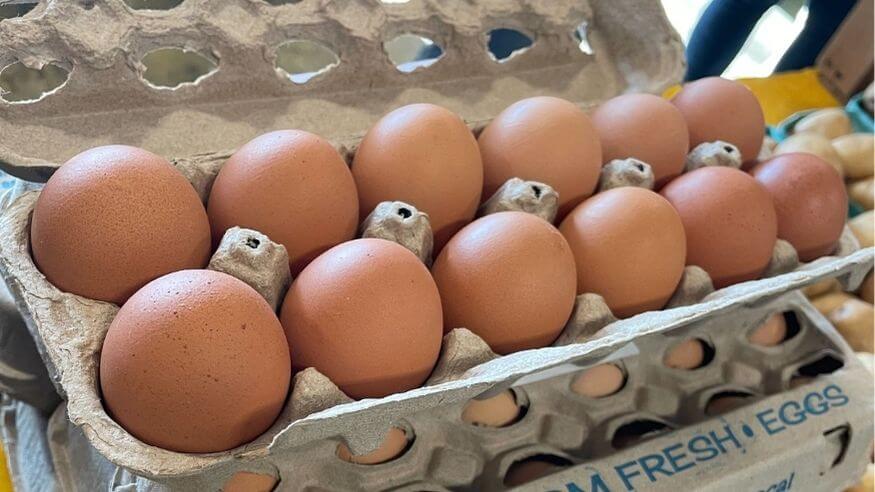
Case in Point, Eggs from Pasture-Raised Chickens
Eggs from pastured hens can contain as much as 10 times more omega-3 fatty acids than eggs from hens that aren’t pastured. [1] It’s the same macronutrient that many people take fish oil supplements for. An estimated 60% of Americans don’t get enough in their diet. [2]
Omega-3s, known as “good fats,” are the most heart-friendly because they’re necessary for every cell and every system in the human body. Sufficient omega-3 levels can also help combat high blood pressure. [3]
Likewise, eggs from pastured hens have been proven to contain:
- ~30% more folic acid [4]
- ~40% more vitamin B12 [4]
- 3-6 times the vitamin D [5]
- 30% more vitamin E [6]
- 1/3 less cholesterol [7]
- and 1/4 less saturated fat [7]
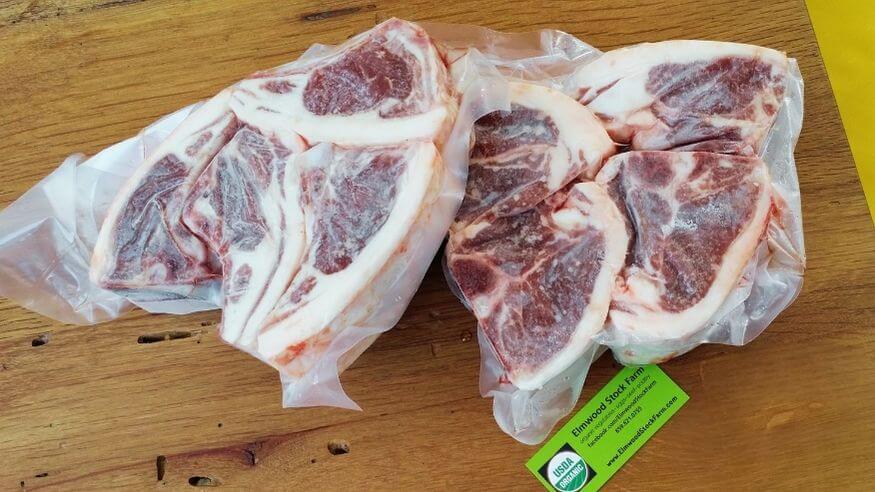
When We Look At Pasture-Raised Meats, We See Very Similar Benefits.
A 2009 study by the USDA and Clemson University researchers completed a comprehensive comparison of grain-fed vs. grass-fed beef. The results were clear. Grass-fed beef was found to be higher in total omega-3s, beta-carotene, vitamin E, thiamin, riboflavin, calcium, magnesium, potassium, and CLA (cis-9 trans-11), a potential cancer fighter. It was found to be lower in total fat, lower in heart disease-associated saturated fats, and posses a lower ratio of omega-6 to omega-3 fatty acids. (1.65 vs 4.84) [8]
A lower ratio of omega-6 to omega-3 fatty acids has been shown to lower the risk of cancer, cardiovascular disease, depression, and obesity, among other things. A ratio of four or lower is considered ideal. [9] The ratio in grain-fed beef is more than 14 to 1. In grass-fed beef, as we just saw, it is approximately 2 to 1. [10]
The reason for the very high vitamin E content in the meat of grass-fed cattle is the very high vitamin E content in fresh grass. [11] We see this pattern across all pasture-raised animals. Chickens forage a bounty of vitamin E from fresh growing grass. [10] Pigs raised on pasture have 300% more vitamin E. [12]
In another USDA study, lamb meat from sheep “grazing pasture had 14% less fat and about 8% more protein compared to grain-fed lamb meat.” [13]
Overall, researchers have concluded that grass-fed meat “should be promoted as an important part of a healthy, balanced diet” because of its superior and beneficial properties. [14]
On the Side of Science
We’ve always sought to deliver an organic product farmed with integrity, for many reasons. One of which are these remarkable health benefits. Providing the nutrition that people need is one of the principles Elmwood is most dedicated to, especially considering that alternatives to pasture-raised can posses insufficient, if not detrimental, levels of these vitamins, minerals, and fat levels.
See what nutrition Elmwood’s pastures can bring to your home. Plan your next meal for family or company with Elmwood’s organic, grass-fed, grass-finished ground Ancestral Blend, the organic pastured Bacon, or a pack of organic, grass-fed, grass-finished lamb chops.
Pick up a dozen eggs at our farm store or farmers market, or order pastured-raised meats for delivery anywhere in the contiguous US.
Sources
[1] Lopez-Bote, C. J., R.Sanz Arias, A.I. Rey, A. Castano, B. Isabel, J. Thos (1998). “Effect of free-range feeding on omega-3 fatty acids and alpha-tocopherol content and oxidative stability of eggs.” Animal Feed Science and Technology 72: 33-40.\
[2] Dolecek, T. A. and G. Grandits (1991). “Dietary Polyunsaturated Fatty Acids and Mortality in the Multiple Risk Factor Intervention Trial (MRFIT).” World Rev Nutr Diet 66: 205-16.
[3] Siscovick, D. S., T. E. Raghunathan, et al. (1995). “Dietary Intake and Cell Membrane Levels of Long-Chain n-3 Polyunsaturated Fatty Acids and the Risk of Primary Cardiac Arrest.” JAMA 274(17): 1363-1367.
[4] A. Tolan et al, “Studies on the Composition of Food, The chemical composition of eggs produced under battery, deep litter and free-range conditions.” Br. J. Nutrition, (1974) 31:185.
[5] https://www.motherearthnews.com/natural-health/free-range-eggs-zmaz09fmzraw/
[6] Lopez-Bote et al, “Effect of free-range feeding on omega-3 fatty acids and alpha-tocopherol content and oxidative stability of eggs.” Animal Feed Science and Technology, 1998. 72:33-40.
[7] https://www.motherearthnews.com/real-food/free-range-eggs-zmaz07onzgoe/
[8] S.K. Duckett et al, Journal of Animal Science, (published online) June 2009, “Effects of winter stocker growth rate and finishing system on: III. Tissue proximate, fatty acid, vitamin and cholesterol content
[9] Simopoulos and Robinson, The Omega Diet, published by HarperCollins in 1999.
[10] G.J. Miller, “Lipids in Wild Ruminant Animals and Steers.” J. of Food Quality, 9:331-343, 1986.
[11] Dietary supplementation of vitamin E to cattle to improve shelf life and case life of beef for domestic and international markets.” G.C. Smith Colorado State University, Fort Collins, Colorado 80523-1171
[12] Mutetikka, D.B., and D.C. Mahan, 1993. Effect of pasture, confinement, and diet fortification with vitamin E and selenium on reproducing gilts and their progeny. J. Anim. Sci. 71:3211.
[13] Turner, K.E., Belesky, D.P., Fedders, J.M. and Solomon, M.B. (1998), Autumn-Grazed Orchardgrass-White Clover Pasture: Nutritive Value of Herbage and Lamb Performance. Journal of Production Agriculture, 11: 85-91. https://doi.org/10.2134/jpa1998.0085
[14] Journal of Agriculture and Food Chemistry, June 2008, 56:4775-4782.)