
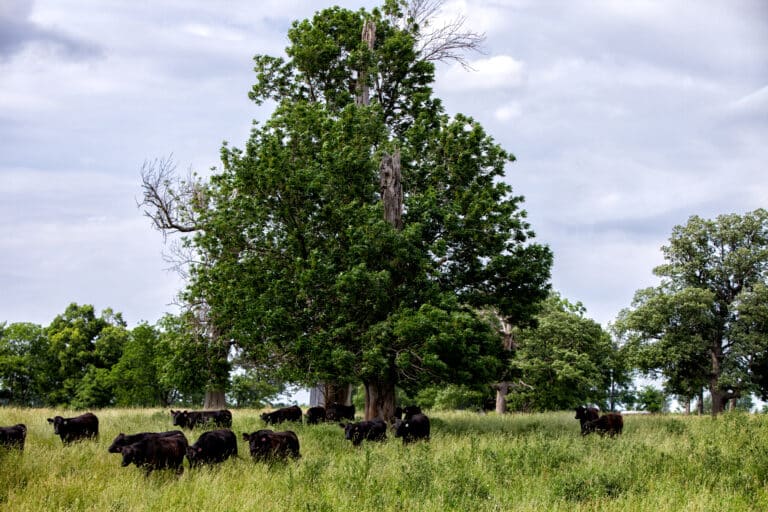
Right now we’re in the midst of haying our pastures and it seemed like an excellent time to revisit a question we frequently get asked: What does it mean for our beef to be 100% grass-fed?
When we say grass we’re referring to both pasture/forage that is directly grazed on and the hay that we cut and bale from those pastures that we reserve for feeding in the winter months.
Cattle, sheep and other ruminants have bacteria in their digestive system that allows them to break down plant material and extract protein, sugar and fat in ways other animals cannot. This takes place in the main component of their digestive system, called the rumen. Grass plays an important role in the function of the rumen by supplying necessary carbohydrates in the form of cellulose. For this reason, our herd relies on grass and it’s what their bodies are naturally designed to eat.
Where we tend to differ though is when it comes to the finishing. Finishing refers to achieving the desired meat characteristics. This commonly occurs in a feedlot with significant amounts of grain to more rapidly put on weight. The reality is that feeding these animals grains puts undue stresses on their digestive systems, creating acidic environments in their stomachs and critically altering their digestive-system functioning.
With a grain-fed production system, all of that grain also requires a lot of water, herbicide, insecticide, synthetic fertilizer, and diesel fuel. Alternatively, during the finishing phase at Elmwood Stock Farm, we follow a rotational grass-based system to achieve a better result without the long list of negative factors. It’s amazing what a herd of cattle can do on well-managed pastures.
It’s not just the health of the animals and the land, but the health of us humans at stake, too. According to a paper published in Nutrition Journal research spanning three decades supports the argument that grass-fed and finished beef has more desirable saturated fatty acids compared to grain-fed beef. It’s also higher in heart-healthy conjugated linoleic acid (CLA) and omega-3 fatty acids, offering a better omega-6 to omega: 3 ratio. Grass-fed beef is also higher in precursors for Vitamin A and E and cancer fighting antioxidants.
We’re fortunate to be able to grow (and bale) our own blend of pasture grass here in the Bluegrass Region of Central Kentucky, known for producing fantastic livestock (include great horses!) Our pastures contains a mix of alfalfa, bluegrass, orchard grass, timothy, and fescue. This “recipe” is the one we’ve found to contain the right combination of protein and sugar to sustain our livestock through the seasons but especially the winter when they need an extra boost of nutrients. It’s also what we’ve found to taste best in the final product.
It’s been an exciting endeavor to dial our practices in to achieve optimal health for the livestock, our customers and the land we all live on. But don’t just take our word for it – we invite you to taste the difference for yourself and see what makes our grass-fed beef so special.