
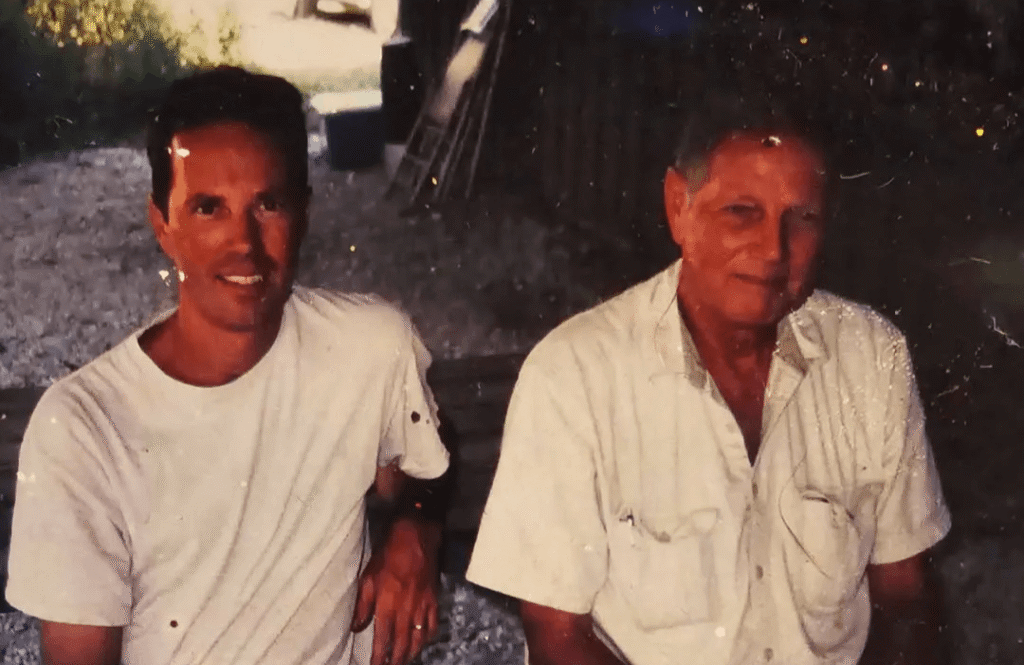
Cecil D. Bell Jr. (right) and his son John Bell (left)
By John Bell
My great-great-great grandfather, David Bell was a share cropper in Nicholas County, Kentucky, where he raised his family. His son, John H. Bell Sr., moved a county west, to Bourbon County, where he was able to own the land he worked.
Cecil D. Bell Jr., father of John Bell and Ann Bell Stone, and patriarch of Elmwood Stock Farm, transitioned his many years of growing burley tobacco to organic vegetables and meats in the 1990s while maintaining his diverse production of cattle, sheep, hay and small grains. In 2024, he was awarded the Legacy Farm Award from Kentucky Farm Bureau.
He was one of the first farmers in the county to implement no-till corn production in the 1970s and to employ new-at-the-time technology of plastic hooped greenhouses for transplant production. The extensive cover crop and livestock rotations employed for decades by Cecil here were the foundational regenerative soil building practices that allowed our successful transition to organic production practices over 25 years ago.
He was always passionate about giving our customers and community only the very best and we are honored to continue that legacy moving forward. This 2017 interview with him gives us a glimpse into how the farm operated in his day and age, what has changed since then, and what parts of life had a lot of meaning to him, like his granddaughter, Lucy Bell.

Cecil Bell Jr. (left) and his granddaughter Lucy Bell (right)
The following interview is from 2017. Cecil Bell Jr. passed in 2025.
How is the farm different now than before Ann and John got involved?
Cecil: We grew 100,000 pounds of tobacco on both farms when I was farming with my dad. Tobacco and cattle were our main things, and everything else would center around them. The cover crops would follow the tobacco. We grew the cover crops as hay, feed grain or green manure to till back into the soil for the next tobacco crop.
When I was a kid, we had sheep and chickens and guineas and pigs. We grew a large garden. Then we started specializing in cattle and tobacco. I guess you could say we’ve come full circle, because now we’re back to having all varieties of crops and animals on the farm.
How has farming changed over the years?
Cecil: We still had draft horses for field work when I was a kid. It was the late 40s when we switched completely from horses to tractors. Tractors are definitely an improvement. Now when you’re feeding hay in the winter, you’re in the cab of a tractor. When you’re tilling ground, you’re not eating all that dirt kicked up by the horses. You can get off the tractor after rolling 100 bales of hay and go into town to the bank and not look cruddy.
My first new tractor was a ’65, which we still use. We still have a 1950-model tractor at the other farm and a 1958-model tractor on the main farm.
When did you know you wanted to farm?
Cecil: I just never thought of anything different. I took ag in school at UK and belonged to the AGR fraternity, the ag fraternity. I was in the ROTC and went into the Army as a second lieutenant. I spent two years in the service in Panama and came back to this farm.
How did the transition of farm work take place from you to John and Ann?
Cecil: I was surprised and happy to work with John and Ann, and in fact I encouraged them to come back and farm. Over a period of time, they took on their own things. As they got involved, that was the time for me to back up. They knew more about the vegetables than I did, so I had to just let them do it.
What’s your favorite time of year?
Cecil: The spring. It’s when the farm is coming to life.
Q: What’s your favorite farm meal?
Cecil: A half-pound cheeseburger with our first heirloom black tomatoes of the year. My granddaughter, Lucy, eats the whole thing, too. My favorite vegetables are my wife, Kay’s, stuffed zucchini and her eggplant casserole.
– Original interview conducted by Lisa Munniksma
We’re proud to carry on Cecil Bell Jr’s legacy by continuously improving on the practices brought about by his principles.
If you have a father in your life that you’re looking to honor this June, consider gifting him a box of fine, organic American meats from a farm with a story. Browse our Father’s Day bundle selections.