
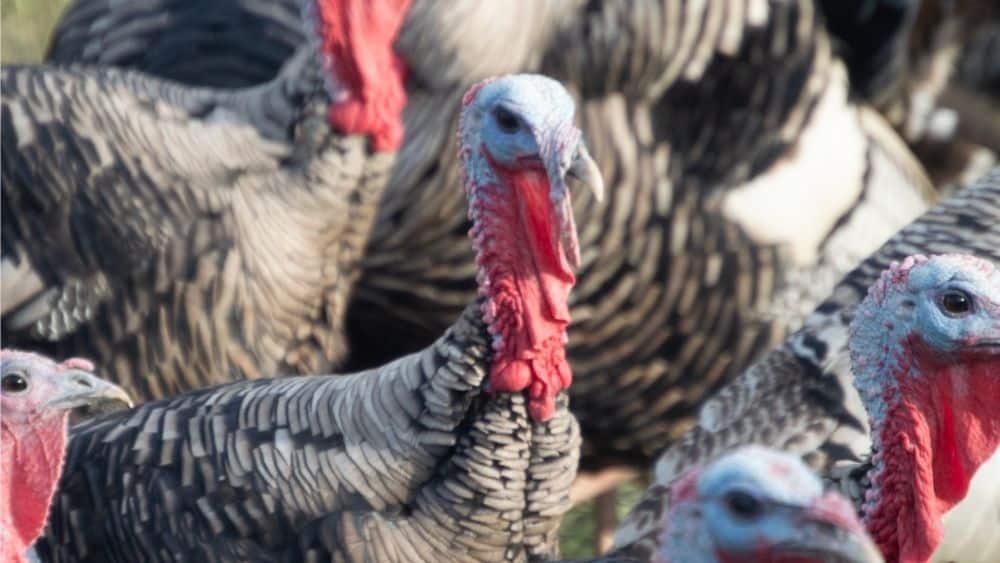
The turkey’s rich history is well deserved, considering how majestic these birds are. And its significance for the time and place in which we find ourselves is something to celebrate. The time? Fall and early winter, around Thanksgiving and Christmas. The place: Here in the Americas.
Why is the Turkey so significant to the United States?
Turkeys are native to the Americas, and according to the American Bird Conservancy, they’re the largest gamebirds in North America. They’re highly intelligent and wary, as well as great runners and short-distance flyers. This helps make them elusive and hard to catch in the wild. Hunters will tell you just how intelligent and perceptive turkeys are.
Heritage turkey breeds, farmed organically by a few operations, are the closest living domestic relatives to the original Wild Turkey. We’re one of those operations raising heritage breeds outdoors, on pasture.
The Old Farmer’s Almanac tells us that “Benjamin Franklin famously criticized the Bald Eagle in a letter about the national seal, calling it “a bird of bad moral character.” He preferred the turkey, writing that it was “a true original Native of America” and “a Bird of Courage.” He even joked that it “would not hesitate to attack a Grenadier of the British Guards” who invaded its farmyard in a red coat.”
If Benjamin Franklin had his way, we’d have the Turkey as a national bird instead.

Why are turkeys a traditional Thanksgiving food?
According to Britannica, the turkey was not the iconic or popular seasonal dish that it is now during the “first Thanksgiving.” In fact, turkey may not have been served at that meal at all – the only matching description we have of the food served was “fowl,” which could just as easily mean a duck or a goose was on the table.
Rather, turkey became a popular dish because of how available it was. Wild turkey was plentiful when the settlers arrived, and it was very common for family farms to raise them for their meat. A single turkey could feed a whole family with ease. Writers like Charles Dickens and Sarah Josepha Hale are also credited with popularizing the image of the holiday turkey in the minds of the American people.

What’s The Significance of an Organic, Pasture-Raised Turkey?
Well, it takes a lot of work to raise turkeys in healthy, ethical, and organic conditions.
We replicate the ideal conditions that turkey eggs experience in the wild, as young turkeys—called poults—are fragile. We modified the old tobacco barn leaf stripping room into a brooding facility for them. The brooder barn has a concrete floor, insulated walls and ceiling, heat, cooling fans, and running water. The poults must be kept at 95°F for a couple of weeks after hatching.
Gradually, the temperature can be backed off over several more weeks, until the ambient temperature is suitable, especially at night. They graduate to the “nursery” room, which is an open pen where they can run and fly a bit and learn that they are birds.
Finally, they graduate to fresh pasture once they can regulate their own body temperatures. They live outside as part of a flock, with access to sun, shelter, fresh water, forages, and organic feed from us, their caretakers. We move their shelter and enclosure periodically to make sure the grasses and clovers they forage through stay fresh. The electric netting that surrounds their home only serves to keep ground predators out of their coop at night. If the turkeys wanted to, they could just fly away. But why would they when life on Elmwood is pretty grand?
The price for these beauties is informed by how much time and manual work it takes to care for them, and the feed it takes to raise them.
The cost for us to process each turkey at an abattoir that handles each one with care is more than what supermarkets will charge for a whole bird. This is because turkeys at the supermarket are usually loss leaders to get people in the door to buy canned sweet potatoes, boxed stuffing, frozen apple pie, and so on.
We are proud to have learned how to raise them on prime bluegrass pastures in a manner that respects their heritage. We tend to their every need from the time they hatch and come into our care. Whichever breed you choose to share with your friends and family this season, you can eat in peace knowing just how much respect was given to them.