
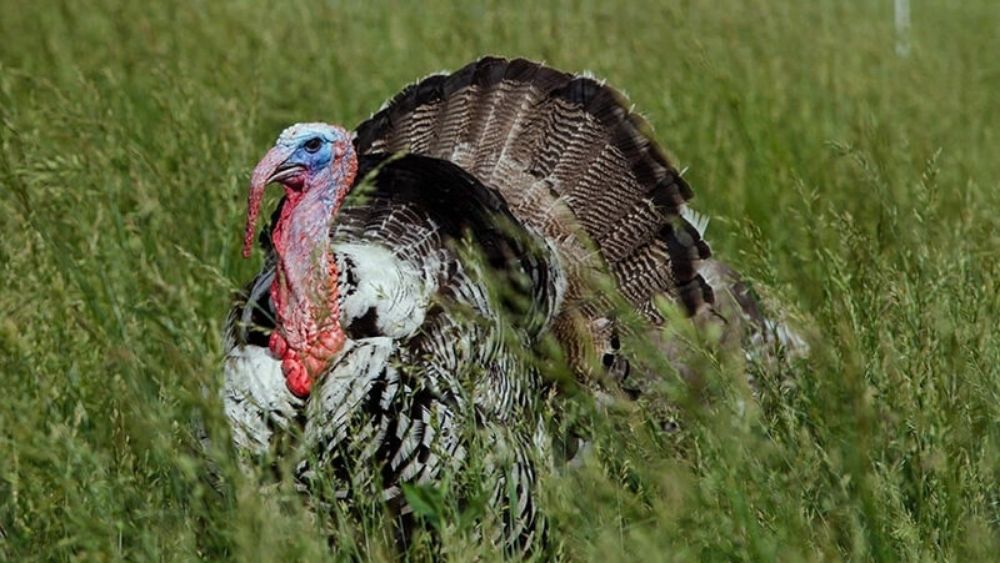
Elmwood Stock Farm has a dedicated breeding flock that lays all the eggs that will become all the heritage turkeys we offer for the holiday season. Some of these toms and hens have been with us for six or eight years. And each year we keep a few more best of the best to bring young stock into our flock. These majestic birds are stately, proud, and prudent—a joy to be associated with.
We hatched a few hundred Narragansett turkey poults at Elmwood Stock Farm in the spring of 2026. Contrast this with 1997, when only six Narragansett breeding pairs were even known to exist in the entire United States of America. I strongly believe that their rebound is a measurable success of the local food movement.
The Rise and Fall of the Narragansett
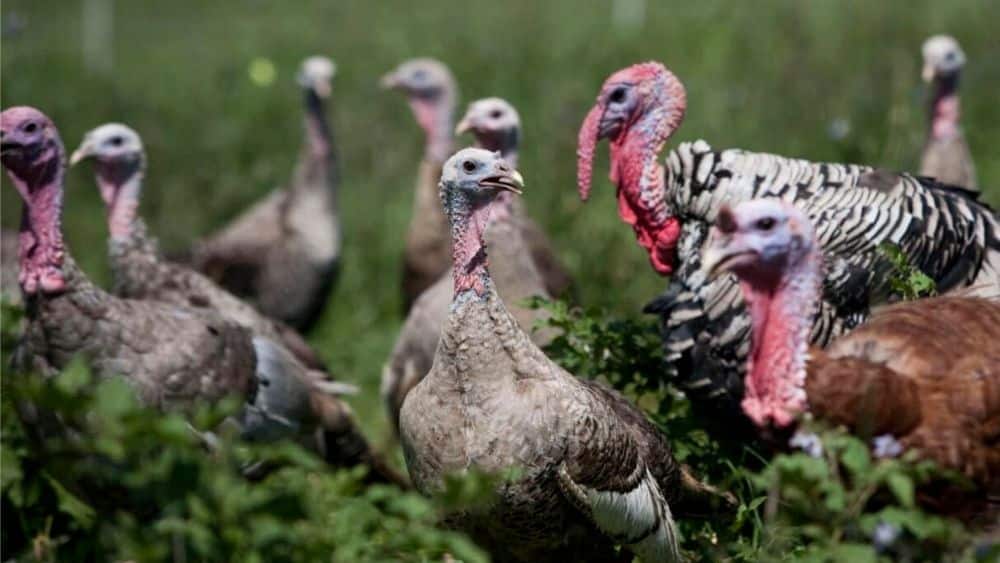
Somewhere in 1800s Rhode Island, a family saw fit to crossbreed an Eastern Wild Turkey with the common domesticated turkey of their day. Why? Maybe they believed that their domestic birds could benefit from inheriting the wild turkey skill for foraging.
This new cross must have been well received on the dinner table because their numbers grew dramatically. This bird’s popularity spread down into the Mid-Atlantic and out to the Midwest. By 1874, they were recognized by the American Poultry Association as a standard breed! This bird had hit the big time.
Or so we thought. As the country matured through the 1900s, the domesticated Broad-Breasted Turkey out-muscled all other breeds. They became favored by turkey breeders as agriculture favored efficiency more and more in its transition to industrialization. The Narragansett turkey breed was left behind. And domesticated breeds of animal often don’t continue if there’s no one willing to raise them.
The Return of the Narragansett
Fast forward to the mid-2000s.
We had heard that The Livestock Conservancy (or the American Livestock Breeds Conservancy, as it used to be known) was asking market farmers like us to help preserve the breed for posterity. As the Conservancy puts it, “rare farm animals represent an irreplaceable piece of earth’s biodiversity.”
Our thinking was: if there is a market for them, we could raise plenty.
There was a little reluctance on their part at first. The concept seemed counter-intuitive: Eat them to save them. But it also seemed like creating demand for this endangered breed could give us the means to perpetuate them. Fortunately, we had already been organically raising the present-day breed of domestic turkeys on pasture for several years. The infrastructure already existed to give this Heritage Breed a place on our farm.
Thus, we secured our very first Heritage Narragansett and Bourbon Red poults.
Narragansett Behavior: Intelligent. Fascinating. Worth Conserving.
Unlike chickens, these birds are seasonal egg layers. They only lay from about early-March until early-May. We gather the eggs daily, then incubate them for 28 days.
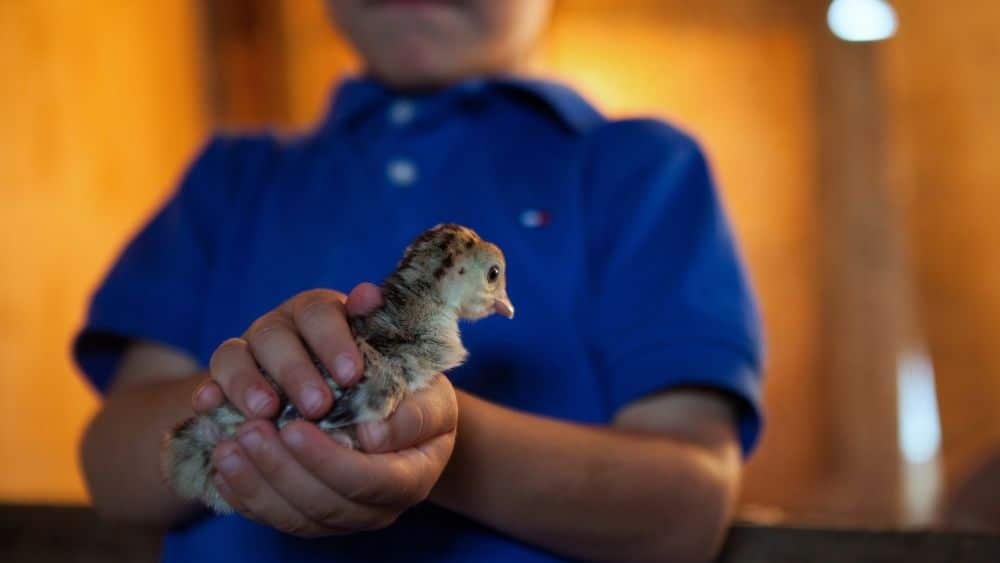
To hatch, the poult chips away at the shell around the egg’s widest part. The little miracle in all this: it cuts out a perfect circle.
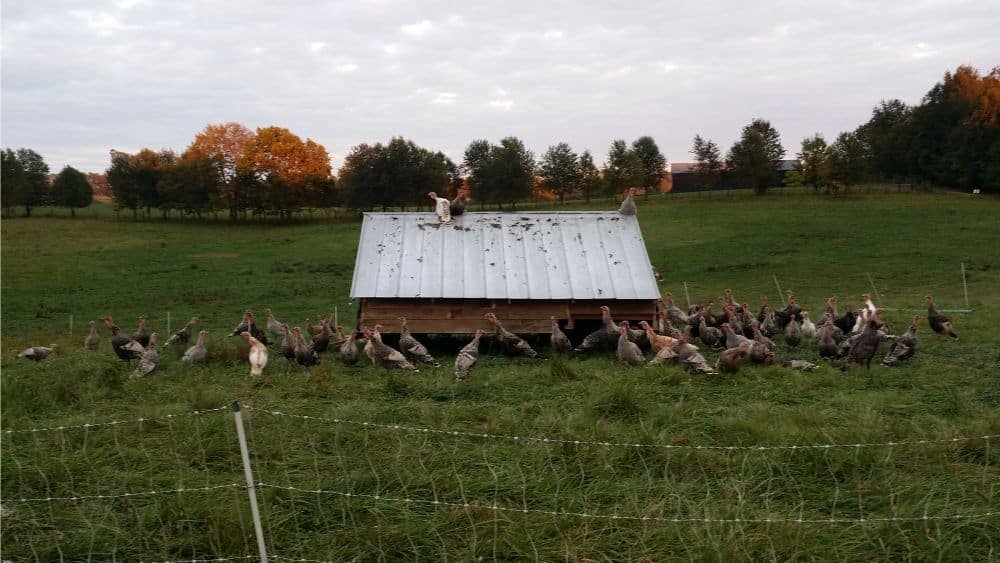
The hens must be awesome mothers in the wild. These little fuzz balls are fragile. They stay warm in a 95°F brooder for 4-5 weeks before we dare put them out to pasture. Once released, they bond with their portable shelter, complete with fresh water and feed. Hawks and owls are their nemesis, so we’ve assembled all manner of netting contraptions to keep these aerial hunters away.
I now see what the original Narragansett breeder was trying to create in their breeding efforts: an athletic, meaty bird. Content to stay on the farm. Unwilling to fly off into the woods. Curious, but with a healthy degree of skepticism. Relaxed when their farmers are nearby. Tense when strangers approach.
Their inclination to warm up slowly to a different watering device or feeder should not be confused with ignorance. It is the very thing that keeps them safe in the wild.
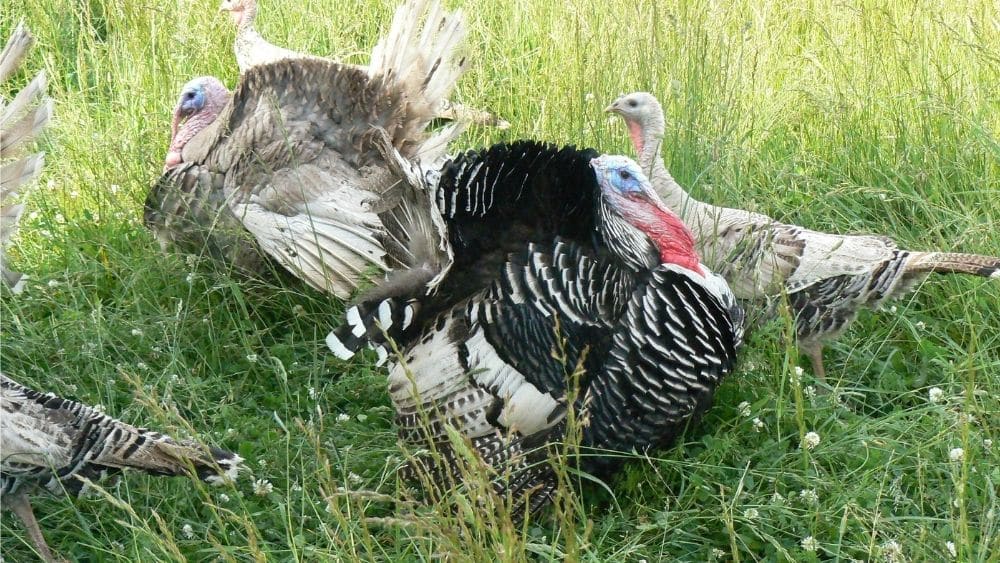
The turkeys use a variety of vocalizations to talk to one another, be it danger-alert chirps or soothing coos. Mature tom turkeys will make a deep, barely audible thumping sound. They’ll do this while splaying their tail feathers and scraping their wings along the ground in a slow strut. The wattles (the fleshy ornamentation that hangs from their necks) become fiery red. A blue hue becomes prominent on the backs of their heads. The toms will all exhibit this flashy behavior at the same time, yet rarely fight with each other. Fascinating.
The Narragansetts’ Place at Elmwood Stock Farm
The first heritage turkey flock at Elmwood would roam the farm by day and roost in the rails of a tobacco barn at night. For the first year, we had to find where they made their nests, then collect the eggs while the hen was off feeding. We did so because turkey hens are very protective. Some so much so that we had to cede the egg and let her hatch them. The most scared I have ever been on Elmwood Stock Farm was collecting turkey poults while keeping mom at bay. To relieve the stress for the turkeys and for us, we built a portable turkey house, complete with communal nest boxes. Simply pop the lid and collect.
That fall, we harvested just a few heritage turkeys to see how they compared to the Broad-Breasted birds we’re all familiar with. Most were kept in order to grow the flock. We loved the texture and flavor, as did the customers included in our focus group. We really had something. Over the years, we increased the size of our breeder flock, which in turn laid more eggs for the next year’s turkey crop.
Heritage breed turkeys are smaller than the conventionally-bred domestic turkeys. The heritage genetics are essentially unchanged since the late 1800s. Hens dress out at 6-12 pounds, and toms run from 12-20 pounds.
The meat is, in a word, luxurious. Its moisture comes from the rich fat under the skin and the marbling throughout.
This meat quality comes about because of how we finish the bird. We don’t just find a big one and say “that one’s ready.” We wait for the birds to reach their mature weight, and allow them to put on a rich layer of fat, as well as fat within the muscle itself.
With our organic, pasture-raised Broad-Breasted turkeys and the Heritage breed turkeys both as options this year, it’s an ideal time to treat yourself and your family to a turkey that’s raised right. In the process, you’ll contribute to creating a demand for the production of these Heritage poultry, keeping them around for many years to come. Your food choices really do make a difference. –Mac Stone